
Wheel Chocks in Spanish Guide for Safer Vehicle Restraint

As industries become more global, multilingual safety communication is increasingly important across transport, warehousing, logistics, construction, and industrial operations. Many businesses working with Spanish-speaking employees or international transport teams often search for the correct term for wheel chocks in Spanish to improve workplace communication and safety training.
In Spanish, wheel chocks are commonly called “calzos para ruedas” or simply “calzos de ruedas.” These safety devices are essential for preventing trucks, trailers, forklifts, caravans, and industrial vehicles from rolling unintentionally during parking, loading, unloading, maintenance, or storage.
How Do You Say Wheel Chocks in Spanish?
The most common Spanish translations include:
Calzos para ruedas
Direct translation:
- “Wheel chocks”
- “Blocks for wheels”
Calzos de ruedas
Another widely used variation meaning:
- “Wheel blocks”
- “Wheel restraints”
Both terms are commonly used in:
- Transport industries
- Warehouses
- Construction sites
- Industrial facilities
- Vehicle maintenance operations
What Are Wheel Chocks?
Wheel chocks are wedge-shaped safety devices placed against tyres to prevent unwanted movement.
They are commonly used for:
- Trucks
- Semi-trailers
- Cars
- Forklifts
- Caravans
- RVs
- Construction machinery
- Mining vehicles
- Industrial equipment
Wheel chocks improve safety during parking, loading, unloading, and maintenance activities.
Why Wheel Chocks Are Important
Prevent Vehicle Rollaways
Vehicles can move unexpectedly on:
- Slopes
- Loading docks
- Uneven terrain
- Wet surfaces
Improve Workplace Safety
Wheel chocks reduce risks for workers operating near heavy vehicles.
Support Loading & Unloading
Stable vehicle positioning improves operational safety.
Protect Equipment & Property
Unexpected movement can damage:
- Cargo
- Loading docks
- Buildings
- Machinery
- Vehicles
Increase Operational Control
Wheel restraint systems improve stability during transport operations.
Common Types of Wheel Chocks
Rubber Wheel Chocks
Rubber wheel chocks provide strong grip and durability.
Best For:
- Cars
- Trailers
- Warehouses
Benefits:
- Slip-resistant
- Weather-resistant
- Strong traction
Heavy-Duty Wheel Chocks
Designed for commercial and industrial applications.
Best For:
- Trucks
- Semi-trailers
- Construction equipment
Benefits:
- High load capacity
- Industrial durability
- Better restraint performance
Polyurethane Wheel Chocks
Polyurethane wheel chocks offer lightweight industrial durability.
Best For:
- Mining
- Outdoor industrial sites
- Transport yards
Benefits:
- Chemical resistant
- Oil resistant
- Long-lasting performance
Wheel Chocks With Handle
Handled wheel chocks improve positioning safety.
Best For:
- Logistics operations
- Loading docks
- Frequent-use environments
Benefits:
- Easier handling
- Reduced bending strain
- Faster positioning
Mobile Wheel Chocks With Handle and Sign
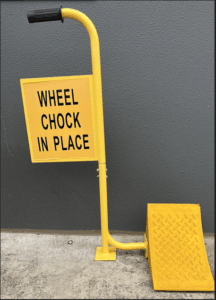
Large industrial operations often require wheel restraint systems that are highly visible and easy to position around heavy vehicles. Mobile wheel chocks with handles and warning signs improve operational safety and workplace efficiency.
Explore heavy-duty wheel restraint solutions here:
Mobile Wheel Chock With Handle and Sign
Key Features
- Heavy-duty industrial construction
- High visibility warning sign
- Extended handle system
- Suitable for large vehicles
- Improved workplace safety
Industries That Use Wheel Chocks
Logistics & Freight
Transport operators secure trucks during loading and unloading.
Warehousing
Loading docks require stable vehicle restraint systems.
Construction
Construction machinery often operates on uneven surfaces where wheel restraint is essential.
Mining
Mining vehicles require heavy-duty wheel chocks for safer operations.
Recreational Transport
Caravans, RVs, and trailers use wheel chocks for parking stability.
Key Features to Look for in Wheel Chocks
Strong Grip Performance
Slip-resistant materials improve tyre restraint.
Heavy-Duty Construction
Durable materials improve operational lifespan.
Weather Resistance
Outdoor use requires UV and moisture resistance.
High Visibility
Bright colours improve workplace awareness.
Proper Size Compatibility
Wheel chocks should match tyre size and vehicle weight.
Best Practices for Using Wheel Chocks
Position Correctly
Place wheel chocks tightly against the tyre.
Use Stable Surfaces
Wheel restraint performs best on solid ground.
Inspect Regularly
Replace worn or damaged wheel chocks immediately.
Support Braking Systems
Wheel chocks should complement parking brakes.
Train Workers Properly
Employees should understand correct wheel chock procedures.
Why Heavy-Duty Wheel Chocks Matter
Professional-grade wheel chocks provide:
- Better workplace safety
- Improved vehicle stability
- Stronger grip performance
- Higher durability
- Reduced operational risk
Explore industrial transport safety solutions here:
Sands Industries & Trading Pty Ltd
FAQs About Wheel Chocks in Spanish
What are wheel chocks called in Spanish?
Wheel chocks are commonly called “calzos para ruedas” or “calzos de ruedas” in Spanish.
What is the purpose of wheel chocks?
They prevent vehicles and machinery from rolling unintentionally.
Are wheel chocks required for trucks?
Yes, heavy vehicles commonly use wheel chocks during loading, parking, and maintenance operations.
What material is best for wheel chocks?
Rubber, polyurethane, and steel are commonly used depending on the application.
Can wheel chocks be used outdoors?
Yes, industrial-grade wheel chocks are designed for outdoor environments and harsh weather conditions.
Conclusion
Understanding wheel chocks in Spanish helps improve communication, workplace safety, and operational efficiency across multilingual industrial and transport environments. Whether referred to as “calzos para ruedas” or “calzos de ruedas,” these essential safety devices help prevent unwanted vehicle movement during parking, loading, unloading, and maintenance operations.
Investing in high-quality wheel chocks improves safety, protects workers and equipment, and supports safer industrial operations across transport and logistics industries.
Contact Information
Sands Industries & Trading Pty Ltd
Unit 27/191, McCredie Avenue, Smithfield, NSW 2175
Phone: +61 4415 9165 | +61 477 123 699